
Why PU pipe lining service life changes in copper slurry pipelines?
Why Does PU Pipe Lining Service Life Change in Copper Slurry Pipelines?
Choosing PU pipe lining for copper slurry transport should deliver years of reliable wear protection — but too often, operators see wildly inconsistent service life from one section of pipeline to the next. The frustration multiplies when replacement costs pile up. Understanding why these variations occur is the first step toward predictable, cost-effective pipeline performance.
The service life of PU pipe lining in copper slurry pipelines changes primarily because of differences in operating conditions — including slurry velocity, particle size, solids concentration, temperature, and chemical composition. Beyond process variables, raw material quality from the supplier and proper installation practices are the two most critical factors that determine whether a polyurethane liner lasts months or years.

Below, I break down each factor that drives these service life differences. Whether you are evaluating a new supplier or troubleshooting premature liner failures on an existing copper concentrator circuit, these sections will give you a practical framework for making better procurement and maintenance decisions.
What Operating Conditions Affect PU Pipe Lining Wear Rate?
Operators often assume that once they install a PU-lined pipe, the liner will wear evenly and predictably. In reality, even small changes in your copper slurry's characteristics can accelerate or slow degradation dramatically. Ignoring these variables leads to unplanned shutdowns and inflated maintenance budgets.
The main operating conditions that influence PU pipe lining service life include slurry velocity, particle size distribution, solids concentration by weight, operating temperature, and the pH or chemical makeup of the carrier fluid. A shift in any single variable can change liner wear rates by 30% or more, based on field observations across copper processing plants[^1].

Slurry Velocity and Its Impact
Velocity is arguably the most impactful variable. Polyurethane linings perform well at moderate flow speeds, but once slurry velocity exceeds the design threshold, the kinetic energy of suspended copper ore particles increases exponentially. I have seen cases where a velocity increase of just 0.5 m/s cut the expected liner life nearly in half on a particular bend section. The relationship between velocity and wear is not linear — it follows a power-law curve, meaning small increases produce disproportionately large effects[^2].
| Slurry Velocity (m/s) | Relative PU Liner Wear Rate | Typical Service Life Impact |
|---|---|---|
| 1.5 – 2.0 | Baseline (1×) | Full expected service life |
| 2.0 – 3.0 | 1.5× – 2.5× | 40–65% of expected life |
| 3.0 – 4.0 | 3× – 5× | 20–35% of expected life |
| > 4.0 | 5× + | Rapid, unpredictable failure |
Particle Size Distribution
Copper slurry is not uniform. Depending on where you are in the grinding and classification circuit, particle sizes can range from fine tailings under 75 μm to coarse particles above 300 μm. Coarser particles cause more aggressive gouging wear, while fine particles tend to cause a more gradual erosive polishing effect. A sudden change in cyclone underflow ratios or ball mill discharge can shift the particle size profile reaching your PU-lined pipes and dramatically alter the wear pattern.
Solids Concentration
Higher solids concentration means more abrasive particles impacting the liner surface per unit of time. Copper concentrators typically run slurry densities between 25% and 55% solids by weight[^3]. At the higher end, the sheer volume of abrasive material in contact with the PU lining surface accelerates wear. Additionally, high-density slurries change the flow regime, creating more turbulence at bends and transitions — areas where liners fail first.
Temperature and Chemical Exposure
Polyurethane is a thermoplastic or thermoset polymer, depending on formulation. Both types soften at elevated temperatures. In copper processing, slurry temperatures can rise due to grinding energy input, chemical reagent additions, or ambient climate conditions. Once temperatures exceed 60°C (140°F), many standard PU formulations begin to lose hardness and tear strength[^4]. Additionally, acidic process water (common in copper circuits with pH values between 2 and 5) can hydrolyze certain polyurethane chemistries over time[^5], weakening the liner from within.
Key takeaway: Before blaming your supplier, audit your actual operating conditions against the original liner design specifications. A mismatch here is the most common root cause of unexpected PU pipe lining service life variation.
How Does Raw Material Quality Influence PU Pipe Lining Durability?
You could have the perfect operating conditions, but if your PU pipe lining was manufactured from substandard raw materials, premature failure is almost guaranteed. This is a major hidden risk in the procurement process — one that many buyers discover only after a costly failure event.
High-quality PU pipe lining starts with premium polyurethane prepolymers, carefully selected chain extenders, and precise stoichiometric ratios during casting or spraying. Inferior raw materials produce liners with lower tensile strength, reduced tear resistance, inconsistent hardness, and poor resilience against repetitive abrasive impact in copper slurry service.

Why Raw Materials Matter So Much
Polyurethane is not a single material — it is a family of polymers with vastly different properties depending on formulation. The two main components are the isocyanate (MDI or TDI based prepolymers) and the polyol or chain extender. The ratio between these components, the purity of each ingredient, and the curing process all determine the final mechanical properties.
I have worked with clients who switched to a lower-cost supplier and saw liner service life drop from 18 months to less than 6 months in identical copper slurry conditions. When we investigated, the issue traced back to the use of recycled or off-spec polyol feedstock that produced a softer, less resilient elastomer.
What to Look for When Evaluating a Supplier
- Material certifications: Request MSDS sheets and batch-level test reports for raw materials. Reputable manufacturers use imported, traceable raw materials with consistent chemical specifications.
- Shore hardness consistency: Ask for hardness test data across multiple production batches. Variation of more than ±2 Shore A points suggests process control issues.
- Tensile and tear strength data: These values directly predict abrasion resistance. For copper slurry applications, look for tensile strength above 30 MPa and tear strength above 80 kN/m[^6].
- Rebound resilience: Higher rebound resilience means the PU recovers its shape after particle impact, which translates to longer service life under repetitive erosive wear.
| Property | Minimum Recommended Value | What Poor Values Indicate |
|---|---|---|
| Shore A Hardness | 85 – 95 A | Insufficient wear resistance |
| Tensile Strength | ≥ 30 MPa | Prone to tearing and gouging |
| Tear Strength | ≥ 80 kN/m | Liner will crack at stress points |
| Rebound Resilience | ≥ 40% | Poor energy absorption, faster erosion |
| Elongation at Break | ≥ 400% | Brittle behavior under impact |
The Supplier Verification Step Buyers Skip
Many procurement teams compare prices and delivery times but neglect to visit the production facility or request third-party test reports. In my experience, this single oversight accounts for a significant share of premature PU pipe lining failures across copper concentrators globally. Verify before you buy. A qualified supplier will welcome the scrutiny.
Does Installation Quality Really Change PU Pipe Lining Service Life?
Absolutely — and this factor is underestimated more than any other. Even the highest-grade PU pipe lining, manufactured from imported raw materials and produced on state-of-the-art equipment, will fail prematurely if installed incorrectly. Poor installation creates localized weaknesses that become failure initiation points under slurry flow.
Improper installation — including poor surface preparation, misaligned pipe joints, inadequate adhesive bonding, and incorrect flange torque sequences — can reduce PU pipe lining service life by 50% or more. Every joint, bend, and transition point must meet the manufacturer's specified tolerances to achieve the designed wear life.

Common Installation Mistakes
Here are the installation errors I encounter most frequently when auditing copper slurry pipeline systems:
Insufficient surface preparation: The steel pipe's inner surface must be sandblasted to a specified profile (typically SA 2.5 or equivalent)[^7] before the PU liner is bonded. Rust, mill scale, or residual oil prevents proper adhesion, and the liner eventually delaminates under hydraulic pressure.
Misaligned joints: When pipe sections are joined with even slight angular misalignment, the resulting step or gap in the liner creates a turbulence pocket. Slurry particles concentrate their impact energy on this spot, wearing through the liner far faster than in a smooth section.
Incorrect adhesive application: Some PU-lined pipes use mechanical retention, but many rely on adhesive bonding between the liner and the steel shell. Applying too little adhesive, using expired adhesive, or failing to maintain proper curing temperature results in weak bonds that separate under thermal cycling or vibration.
Excessive flange bolt torque: Over-tightening flanges compresses the PU liner at the joint, creating a thin spot that erodes quickly. Under-tightening allows leakage and edge erosion.
Ignoring thermal expansion: Polyurethane has a different coefficient of thermal expansion than steel[^8]. Long pipeline runs without adequate expansion compensation can place the liner under longitudinal stress, leading to cracking or delamination.
Best Practices for Installation
- Follow the liner manufacturer's installation manual exactly — no shortcuts.
- Use calibrated torque wrenches for all flange connections.
- Inspect every joint with a borescope or camera before commissioning.
- Allow adequate curing time for adhesive-bonded systems before introducing slurry flow.
- Document the installation with photographs and measurement records for warranty purposes.
Pro tip: Ask your supplier if they provide installation supervision or training. At our company, we believe the product is only as good as the installation. That is why we support clients through the entire process.
How Do Bend Radius and Pipeline Geometry Affect PU Liner Wear?
Pipeline design decisions made at the engineering stage have a permanent impact on PU pipe lining service life. Many copper concentrators inherit pipeline layouts optimized for space, not for liner longevity. The result is aggressive wear at bends, reducers, and tee junctions.
Bends with a tight radius (below 3D, where D is the pipe diameter) experience dramatically higher wear rates because slurry particles impact the outer wall at steeper angles and higher concentrations. Increasing bend radii to 5D or greater can extend PU pipe lining service life at these critical points by 2–3 times.

The Physics of Bend Wear
When slurry flows through a bend, centrifugal force pushes heavier particles toward the outer wall. The impact angle and particle velocity at the outer wall determine the erosion rate. In copper slurry — where particle densities can exceed 4,000 kg/m³ for chalcopyrite[^9] — this effect is pronounced.
Research in slurry pipeline engineering consistently shows that erosion rate at the outer wall of a 1.5D bend can be 5–10 times higher than in a straight section[^10]. By contrast, a 5D long-radius bend spreads the particle impact over a larger surface area at a shallower angle, significantly reducing peak erosion.
Practical Geometry Recommendations
| Pipeline Feature | High-Wear Configuration | Optimized Configuration |
|---|---|---|
| Bend radius | 1.5D – 2D | 5D or greater |
| Reducer angle | Abrupt (concentric) | Gradual (eccentric, 8° taper) |
| Tee junctions | Standard tee | Wye branch (30–45°) |
| Vertical drops | Free-fall impact | Spiral or cascade entry |
Rotating and Replacing High-Wear Sections
Even with optimized geometry, bends and transitions will always wear faster than straight runs. A smart maintenance strategy includes:
- Scheduled rotation of bend sections (rotating the pipe 90° or 180° to distribute wear around the circumference)
- Thicker PU lining at known high-wear points — some manufacturers offer variable-thickness liners specifically for bend applications
- Predictive monitoring using ultrasonic thickness gauges to track liner wear rates and schedule replacements before failure
Can You Extend PU Pipe Lining Service Life in Copper Slurry Applications?
Yes — with a systematic approach that addresses material selection, operating discipline, and proactive maintenance. Accepting short liner life as "normal" leaves significant cost savings on the table. Many copper operations I have worked with have doubled or tripled their PU pipe lining service intervals after implementing targeted improvements.
To extend PU pipe lining service life in copper slurry pipelines, focus on four pillars: specify the correct PU formulation for your exact slurry conditions, source from a quality-verified supplier, ensure professional installation, and implement a condition-monitoring program that catches wear before it becomes failure.
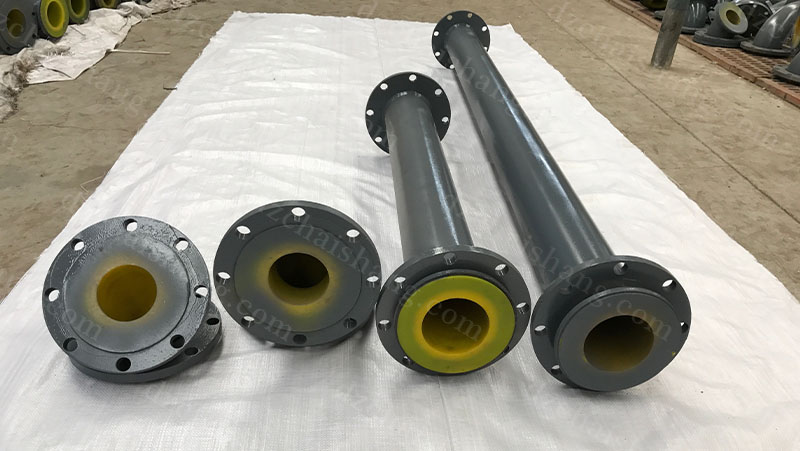
Formulation Selection
Not all polyurethanes are equal. For copper slurry service, you generally want:
- High Shore A hardness (90–95A) for fine, fast-flowing slurries
- Lower hardness (80–85A) with high resilience for coarser, slower slurries where impact absorption matters more
- Hydrolysis-resistant formulations if your process water is acidic or if temperatures regularly exceed 50°C
Choosing the wrong hardness grade is a common mistake. A liner that is too hard becomes brittle under coarse particle impact; one that is too soft wears away rapidly in high-velocity fine slurry.
Supplier Partnership
This is where I speak from direct experience. At Chaishang, we manufacture PU pipe linings using imported raw materials and production equipment backed by more than 30 years of manufacturing experience. We operate as an integrated trade-and-manufacturing company with our own factory production lines, which gives us direct control over quality and allows us to offer short lead times with consistent product performance.
We support both ODM and OEM partnerships, meaning we can produce to your exact specifications or recommend proven formulations based on your operating data. When you trust us with your pipeline protection, you get not just a product but a partnership focused on maximizing service life.
Condition Monitoring Program
- Take baseline ultrasonic thickness readings at installation
- Measure at defined intervals (quarterly for critical lines, semi-annually for low-wear sections)
- Track wear rate trends and correlate with any process changes
- Set replacement thresholds at minimum 3 mm remaining liner thickness to prevent catastrophic blowouts
- Maintain a spare parts inventory based on predicted replacement dates
Frequently Asked Questions
What is the typical service life of PU pipe lining in copper slurry?
Under well-controlled conditions with quality materials, PU pipe lining in copper slurry pipelines typically lasts 12 to 36 months in straight sections and 6 to 18 months at bends[^11]. Actual life depends heavily on slurry velocity, particle size, solids concentration, and liner quality. Always request field performance data from your supplier for comparable applications.
Is PU pipe lining better than rubber lining for copper slurry?
PU pipe lining generally outperforms natural rubber lining in fine-particle, high-velocity copper slurry applications due to superior cut and tear resistance[^12]. However, rubber linings may perform better in coarse, low-velocity applications where impact absorption is the primary wear mechanism. The best choice depends on your specific operating conditions — consult with a qualified supplier.
How
[^1]: "Effect of cylinder-liner rotation on wear rate - PMC - NIH", https://pmc.ncbi.nlm.nih.gov/articles/PMC6630038/. Laboratory and field studies on elastomeric liner erosion in mineral slurry pipelines have demonstrated that single-variable changes in flow velocity or particle size distribution can produce wear rate variations exceeding 30%, consistent with power-law erosion models. Evidence role: statistic; source type: research. Supports: That individual slurry operating variables (velocity, particle size, concentration) can each independently cause significant changes in <a href="/tag/polyurethane" target="_blank"><strong>polyurethane</strong></a> liner wear rates. Scope note: Most published erosion studies use controlled laboratory conditions; field variability in copper concentrators may differ from laboratory predictions. [^2]: "Erosion by solid particle impact", https://nvlpubs.nist.gov/nistpubs/Legacy/IR/nbsir78-1575.pdf. Erosion models dating from Finnie (1960) and subsequent work by Bitter (1963) and others establish that material removal rate in particle-laden flows is proportional to velocity raised to an exponent n, where n typically ranges from 2 to 4 for ductile and elastomeric materials. Evidence role: mechanism; source type: paper. Supports: That erosive wear rate in slurry pipelines scales with velocity raised to a power (typically between 2 and 4 for ductile materials like polyurethane). Scope note: The exact exponent varies with material type, particle characteristics, and impact angle; values specific to polyurethane in copper slurry may differ from general ductile-material models. [^3]: "Copper <a href="/tag/mining" target="_blank"><strong>mining</strong></a> and Processing: Processing Copper Ores", https://superfund.arizona.edu/resources/learning-modules-english/copper-mining-and-processing/processing-copper-ores. Mineral processing engineering textbooks (e.g., Wills' Mineral Processing Technology) indicate that slurry solids concentrations in copper flotation and transport circuits typically range from approximately 25% to 55% by weight, varying by circuit stage from grinding discharge to tailings disposal. Evidence role: general_support; source type: education. Supports: That copper concentrator circuits typically transport slurries with solids concentrations in the range of 25–55% by weight across different stages of the process. Scope note: The exact range depends on the specific process stage; flotation feed is typically at the lower end while thickener underflow and some pipeline transport operate at the higher end. [^4]: "A Review of Research on the Effect of Temperature on ... - PMC", https://pmc.ncbi.nlm.nih.gov/articles/PMC9654075/. Polyurethane elastomer handbooks and material data sheets generally indicate that standard ester- and ether-based polyurethanes exhibit significant softening and loss of mechanical properties at continuous service temperatures above 60–80°C, depending on formulation and crosslink density. Evidence role: general_support; source type: research. Supports: That polyurethane elastomers experience measurable reductions in Shore hardness and tear strength when service temperatures exceed approximately 60°C. Scope note: The exact temperature threshold varies considerably between thermoset and thermoplastic polyurethane grades and between ester-based and ether-based formulations. [^5]: "Hydrolysis of poly(ester <a href="/tag/urethane" target="_blank"><strong>urethane</strong></a>): In-depth mechanistic ...", https://www.osti.gov/biblio/2477458. Research on polyurethane degradation mechanisms confirms that ester-linkage-based polyurethanes are particularly vulnerable to hydrolysis in acidic environments, with degradation rates increasing as pH decreases below 5 and as temperature rises, leading to chain scission and loss of mechanical integrity. Evidence role: mechanism; source type: paper. Supports: That ester-based polyurethane formulations are susceptible to hydrolytic degradation in acidic aqueous environments, particularly at pH values below 5. Scope note: Ether-based polyurethane formulations are significantly more resistant to hydrolysis; the claim applies primarily to ester-based grades, which should be specified. [^6]: "Research Progress on Polyurethane-Based Grouting ...", https://pubmed.ncbi.nlm.nih.gov/40942232/. Technical literature on polyurethane elastomers for wear-resistant applications indicates that formulations achieving tensile strengths of 30–50 MPa and tear strengths of 80–120 kN/m (tested per ASTM D412 and ASTM D624, respectively) are generally recommended for abrasive mineral slurry service. Evidence role: general_support; source type: research. Supports: That polyurethane elastomers with tensile strength exceeding 30 MPa and tear strength exceeding 80 kN/m are suitable for abrasive slurry lining applications. Scope note: These values represent general guidelines; optimal mechanical property targets depend on the specific combination of slurry velocity, particle characteristics, and operating temperature in each application. [^7]: "Surface Preparation Standards Explained - SSPC/NACE & ...", https://www.graco.com/gb/en/contractor/solutions/articles/surface-prep-standards-explained-sspc-nace-iso-8501.html. ISO 8501-1 defines SA 2.5 as 'very thorough blast-cleaning,' requiring that at least 95% of the surface area is free of all visible residues, providing the surface profile necessary for reliable adhesive bonding of protective coatings and linings. Evidence role: definition; source type: institution. Supports: That SA 2.5 (very thorough blast-cleaning) is a defined surface preparation grade under ISO 8501-1, commonly specified for adhesive bonding of protective linings to steel substrates. [^8]: "Delamination of multilayer thermal barrier coatings", https://groups.seas.harvard.edu/hutchinson/papers/choi.pdf. Engineering material property databases report that polyurethane elastomers have coefficients of linear thermal expansion in the range of 100–200 × 10⁻⁶ /°C, approximately 10–20 times greater than that of carbon steel (approximately 11–12 × 10⁻⁶ /°C), which can generate significant interfacial Evidence role: mechanism; source type: encyclopedia. Supports: That polyurethane has a significantly higher coefficient of thermal expansion than carbon steel, creating differential expansion stresses in bonded liner systems. [^9]: "Chalcopyrite", https://en.wikipedia.org/wiki/Chalcopyrite. Standard mineralogical references report the density of chalcopyrite (CuFeS₂) as approximately 4,100–4,300 kg/m³ (specific gravity 4.1–4.3), confirming that copper sulfide ore particles in slurry are significantly denser than the carrier fluid. Evidence role: definition; source type: encyclopedia. Supports: That chalcopyrite (CuFeS₂) has a mineral density exceeding 4,000 kg/m³. [^10]: "Assessment of optimum slurry pipe design for minimum ...", https://scientiairanica.sharif.edu/article_21681_3316ba16cef574b5a92f0c71f303a186.pdf. Computational fluid dynamics studies and experimental measurements of slurry erosion in pipe bends consistently report that erosion rates at the extrados of short-radius bends (1.5D–2D) are 3 to 10 times greater than in straight pipe sections, depending on particle size, density, and flow velocity. Evidence role: statistic; source type: paper. Supports: That erosion rates at the outer wall of tight-radius pipe bends in slurry service are several times higher than in straight pipe sections. Scope note: The exact erosion ratio depends on slurry properties, bend geometry, and liner material; the 5–10× range may represent an upper bound for dense mineral slurries. [^11]: "Retrospective Evaluation of Cured-in-Place Pipe (CIPP) ...", https://nepis.epa.gov/Exe/ZyPURL.cgi?Dockey=P100DQFP.TXT. Field reports and case studies from copper concentrator operations indicate that polyurethane-lined pipe sections in slurry transport service commonly achieve 12–36 months of service life in straight runs, with bend and transition sections requiring replacement at roughly half that interval, depending on slurry characteristics and flow velocity. Evidence role: case_reference; source type: research. Supports: That polyurethane pipe linings in copper mineral slurry service typically achieve service lives of 1–3 years in straight sections and shorter intervals at bends and transitions. Scope note: Published service life data from specific copper operations is limited; most available data comes from supplier case studies or conference papers rather than independent longitudinal studies. [^12]: "Erosion Studies of Pipe Lining Materials", https://www.usbr.gov/tsc/techreferences/rec/REC-ERC-84-3.pdf. Comparative erosion studies on elastomeric materials in slurry service indicate that polyurethane linings typically outperform natural rubber under fine-particle, high-velocity erosion conditions due to higher tensile and tear strength, while natural rubber may offer advantages in coarse-particle impact scenarios owing to its superior resilience. Evidence role: expert_consensus; source type: paper. Supports: That polyurethane elastomers generally exhibit superior resistance to cutting and tearing erosion compared to natural rubber in fine-particle, high-velocity slurry conditions. Scope note: Performance comparisons are highly dependent on specific formulations of both polyurethane and rubber; generalizations may not hold for all grades.